

Only at the client's request, by contract
Custom Programming Without AI
As an exception, if a client requests it, we program without generative AI: all the code is conceived and written by the developer.
What does programming without generative AI mean?
That no AI agent or assistant, such as Claude, GitHub Copilot, Antigravity or the Xcode assistants, is involved in developing the code.
Excluded
- AI agents and assistants that write code autonomously.
- Sending the code, documentation or project data to any AI service.
- Using AI for tests, documentation or security review, unless the contract allows it.
Still used
- The editor, the compiler and version control with Git.
- Traditional syntax analyzers.
- Automated tests and automatic release of each version with continuous integration, with no AI integration.
Each client can extend or narrow the use of AI according to their requirements, and it is set out in writing in the contract. Programming without AI does not prevent the product from having artificial intelligence features either: an application programmed without AI can integrate an AI model to offer certain features; the only thing that changes is how it is developed.
Who would want to commission development without generative AI?
When legal protection, intellectual property or strict regulations require human traceability.
Confidentiality of code and data
Neither the code nor the project data goes through third-party AI services. It is a protection and privacy measure for algorithms and sensitive information.
Internal rules and contractual requirements
Some organizations have internal rules on the use of AI, or clients that restrict it. We adapt to them and put it in writing.
Tool control and traceability
Knowing which tools have been involved in the software and who wrote each part, with the full repository history.
Confidence of management
Some managers and technical leads do not trust AI for development, and prefer to rely on a company with experience in development projects that can control exactly all the code that makes up a project.
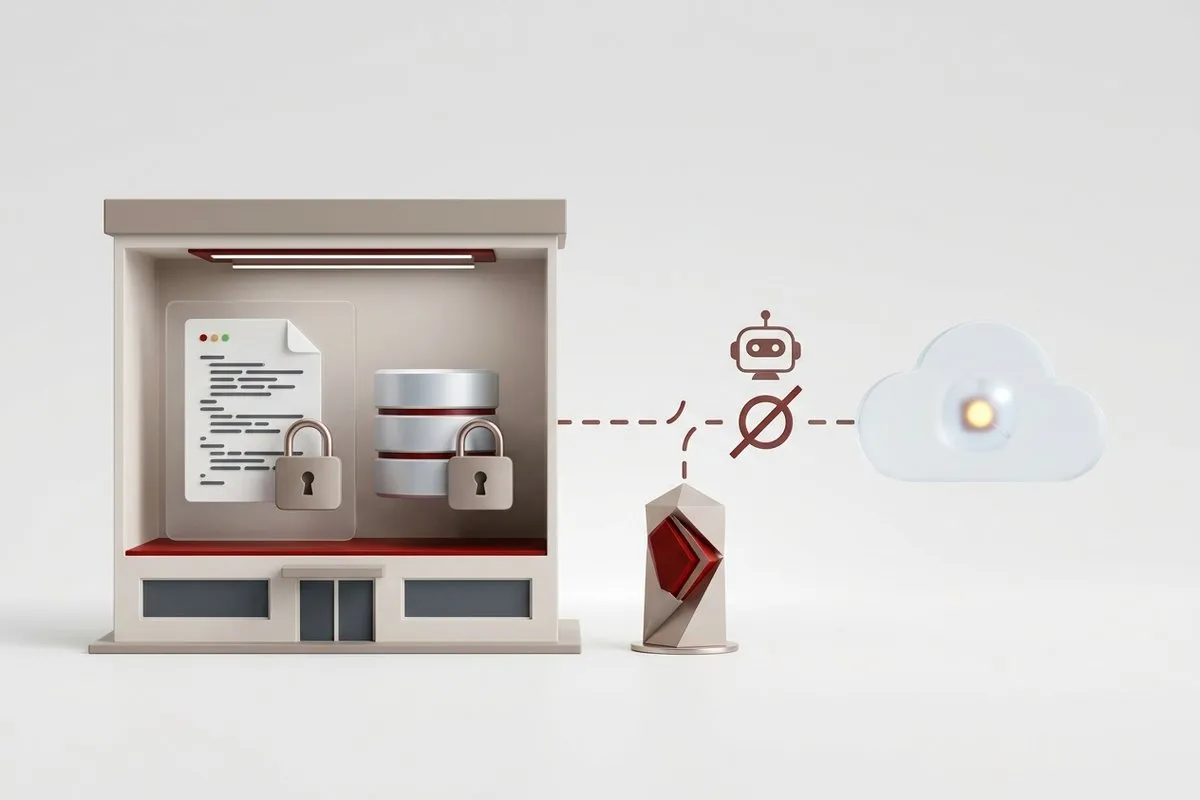
By default, at Gilsys we make use of generative AI tools to enhance our development processes. However, when regulations, confidentiality or the client's preferences require it, we develop projects 100% free of AI-generated code: we have been doing custom programming for more than 20 years.
Consequences of AI-generated code in recent years
AI has multiplied the amount of code being written. Industry studies suggest that the volume of copied code and of errors is also increasing.
×3.4
commits on GitHub in two years: from 10 billion to 34.3 billion
GitHub Octoverse 2026, from 2024 to 2026
40%
of pull requests are now started by an AI agent; in March, 17%
GitHub Octoverse 2026, September data
+68%
issues in pull requests made with AI compared with human ones: 10.83 on average versus 6.45
CodeRabbit, December 2025, with 470 open source pull requests
Less code is reorganized and more is copied
Percentage of lines of code changed each year worldwide
Reorganized: lines moved to another file or function without changing them, which is usual when reusing code. Copied: the same lines added in several places in a single change.
AI has produced code faster, but also more errors
Each team compared with itself: its quarters with the most AI use versus those with the least
2025 report (more than 10,000 developers)
2026 report (22,000 developers)
Faros AI, 2025 and 2026 reports, with real usage data from the teams. The two reports are different samples.
It is not a problem with AI, but with how it is used.
Many of those who arrive on GitHub start programming directly with AI, without the experience to review what it generates, and that code also counts in the statistics. But the professional teams that use it most also record more errors. At Gilsys we use it with judgment and review and, if the client requests it, we can do without it.
Studies by companies that sell code analysis or AI tools, with methods that differ from one another. Sources: GitHub Octoverse 2025, GitHub Octoverse 2026, GitClear 2025, GitClear 2026, CodeRabbit 2025, Faros AI 2025, Faros AI 2026.
We adapt to the limits set in the contract
By default, we rely on AI where it brings technical benefits, but if the client needs it, each of these phases can be customized or blocked by contract.
Requirements review and briefing
AI can help organize the project documentation. It can be agreed that it does not go through any AI, and our team will analyze everything manually.
Writing the code
The use of generative AI can be blocked completely, to avoid sending the code to external companies or being influenced by suggestions that, even if they work, differ from exactly what a professional developer would write. The code will be 100% written without AI.
Tests
They can be written without AI or only with the AI the client authorizes, for example a local model.
Documentation
It can be written without AI or only with the AI the client authorizes.
Second review and security
It can be done only with the AI the client authorizes, or with manual review and traditional tools.
Deployment
We usually work with GitHub Actions or our own scripts. If desired, the involvement of AI in continuous integration processes can also be limited.
How it is agreed and how it is verified
We have been doing custom programming since 2004, and for most of that time, without AI: doing so on certain projects is not a problem.
- 1
We define the scope
With the client's requirements: what is excluded, which tools can be used and whether AI is allowed for tests, documentation or review.
- 2
We put it in the contract
The modality and its limits. Any exception only applies with the client's written authorization.
- 3
We agree on the evidence
Whatever the client asks for: for example, the repository in their account with its full history, the list of tools used in the project or computers without AI assistants installed.
- 4
Our team does the work
We do not work with subcontractors: all the code is written and reviewed by the same team that signs the contract.
More than 20 years programming without AI back our technical capability
Custom programming since 2004
For most of that time, without AI. Doing without it is not changing method; it is returning to a way of working that we know well.
What we have learned with AI
We also use it to learn: we test the improvements it suggests and, when they are good, we adopt them. That knowledge stays in the team and we also apply it when we program without AI.
The same standards in any modality
Version control, automatic release of each version and code review: they are part of all our projects.
We set the criteria
With AI or without it, the technical decisions are ours. We explain it in how we program with AI.
An uncommon modality
Few development companies offer it today. We can do it because we have been doing custom programming since long before generative AI existed.

Frequently asked questions about programming without AI
Can software programmed without AI have artificial intelligence features?
Which tools are not used and which are?
How is compliance verified?
Can the code be reviewed with a local AI?
How much does programming without AI cost?
Is code written without AI more secure?
AI itself is not what is unsafe: the real risk is unreviewed code and, worse still, code that the person signing it does not understand.
In the end it makes no difference whether a line is suggested by a model or typed by a person; the danger appears when code is accepted blindly. An AI can make subtle mistakes just like an inexperienced developer. That is why security never depends on the tool, but on having programmers with the necessary judgment and experience behind it.
Are there restrictions on the use of generative AI to develop your project?
Tell us what restrictions you have, what you want to be able to verify and what level of confidentiality you need, and we will prepare a proposal for you.