

Professional websites for large companies
Custom web development
with high performance
Websites built with Astro, managed with Sanity, connected to your company's systems and measured with our SEO monitoring tool.
What an enterprise website includes
A manageable custom website, connected to the company's systems, with SEO/GEO visibility that is monitored and optimized regularly.
Performance, security and SEO
A custom website built with Astro, lightweight and prebuilt.
Content management with Sanity
A custom panel to edit and publish without touching code, with a preview of every change.
Three work environments
Development, integration and Studio, with snapshot publishing and the option to return to a previous version.
Connection with other systems
Data from a PIM such as Pimcore, from an ERP or from any API, integrated into the website blocks.
Islands and custom tools
Interactive blocks, such as a product configurator, cleanly embedded in the website.
SEO/GEO optimization tool
Connected to Search Console, Analytics and tools for measurement and analysis with AI.
Websites built with Astro
High-performance, secure websites built for SEO and GEO
Astro generates lightweight, prebuilt websites: they load fast, are secure and are ready for search engines.
Speed
Astro generates prebuilt HTML and does not send JavaScript to the browser except for the blocks that need it, so pages load fast on mobile too.
Technical SEO
Full control of titles, descriptions, headings, structured data, sitemap and language versions (hreflang).
Optimized images
Astro optimizes images automatically: it converts them to lightweight formats and generates versions in different sizes, so each device downloads the one that suits its screen. On this website, a 3.3 MB original image is served at about 69 kB.
Security
In production there is only static HTML, with no exposed database or admin panel, and no third-party plugins to update.
Scalability
Static pages handle traffic peaks without slowing down, because the server does not have to generate them on every visit.
Multiple languages
Each language with its friendly URLs and hreflang, and the equivalences between languages defined in a single place, as on this website, in Spanish, Catalan and English.
Our own website proves it: of its 241 pages, built with Astro, 185 score 100 out of 100 in PageSpeed Insights for mobile, and the average is 99.6 (October 2026 measurements). See for yourself in the gilsys.com benchmark.
SEO and GEO
Ready for AI search engines (GEO)
GEO is positioning in the search engines and assistants that answer with AI, such as Google's AI Mode, ChatGPT or Perplexity. Our development includes what they need to read, understand and cite the website:
Structured data
Each page describes its content in JSON-LD (schema.org), with metadata by page type: the company, the site, the breadcrumb trail, articles or frequently asked questions.
Directives for robots
The robots.txt file tells search and AI robots what they can read, and allows them to use the website content to answer and to train.
Content in the HTML
The text is in the HTML from the start, so AI robots read it without running JavaScript. Even animated indicators, which count up from zero, have their final value in the HTML, and transitions and scroll effects do not hurt performance.
Agentic navigation
Semantic headings, links and menus that allow AI agents to browse the website and find what they are looking for.
Direct answers
Definitions, comparisons and frequently asked questions written so that an assistant can cite them as they are.
Measured in the assistants
Our SEO monitoring tool checks whether AI answers cite the website and which AI robots read it.
Custom-built CMS integrated with an editor
Custom content management with Sanity
With Sanity*, the client manages the website from a panel built for their project, the Studio. It is not a free-form editor like Elementor, where the result depends on who edits: the website is built with predefined, configurable structures and specific options.
Predefined blocks
Cards, indicators, calls to action, quotes, contact forms or news, prepared for the website design.
Specific options
For example, in a card block you choose the title and subtitle, the background from six options, the number of columns, whether the cards are grouped in tabs and whether they have buttons, and you can even select whether certain data is filled in by hand or taken from external sources such as Pimcore.
Consistency across all pages
Each page has certain specific design options, so the marketing or editorial team can focus on the content, not on the look and feel.
Changes to blocks, through development
If a new block needs to be created or new options added, it has to be developed in the code so that everything is optimized.
What the client does
Edit text and images, create new pages, posts and sections, work in several languages and see every change in the preview before publishing it.
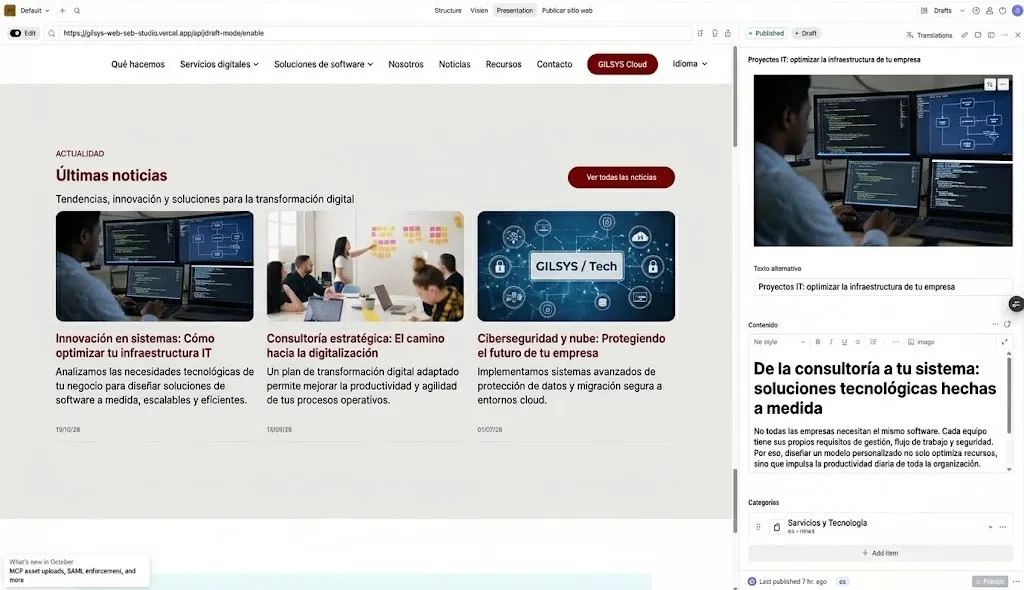
* The free Sanity account offers up to 20 users and 2 roles.
How we work
We offer three environments, with a snapshot-based publishing system
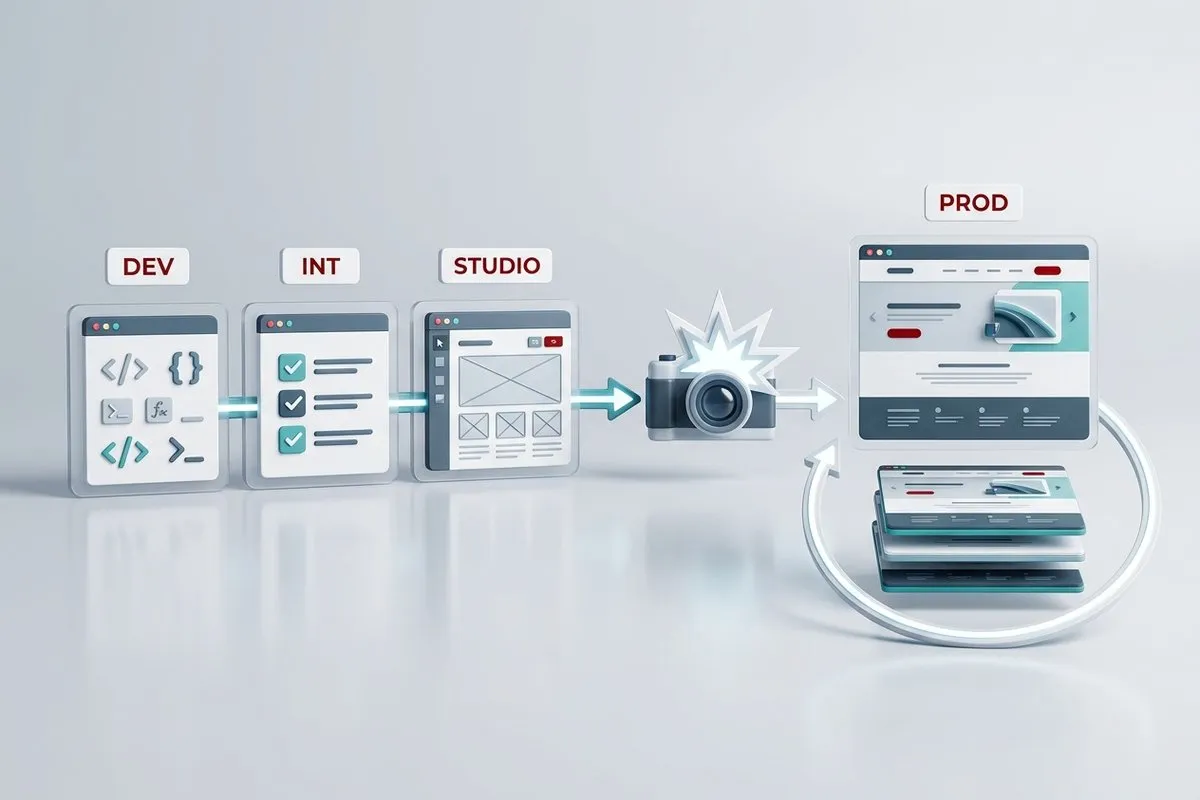
Each enterprise website works with three separate environments, so nothing reaches production without being reviewed.
Development
Our team’s environment, where new features are developed. The code is managed in a private Git repository.
Integration
Each new version is deployed automatically to this environment, where the client reviews its new features and runs tests without altering anything that is published.
Studio
The environment where the client works day to day, preparing the new version. It is possible to browse the website, edit sections live and create new ones. When the whole website is as it should be, it is published.
Publication
Publication is launched from the Studio itself: a snapshot of everything in it is compiled and deployed automatically to production in a few minutes. Every publication is recorded, and it is possible to return to a previous version.
Connection with other systems
Websites connected to PIM, ERP and external APIs
An enterprise website can display data from other company systems: products from a PIM such as Pimcore, data from an ERP or from any API.
Blocks fed by the PIM
For example, on some projects we have programmed Sanity components in which tags for product groupings are specified. The content of that block, whether a table or a carousel, then draws on remote information loaded from an external tool, such as a PIM or an ERP.
Live data while the version is being prepared
In the integration and Studio environments, data is read in real time from the external tool, so the team always works with current information.
Production, prebuilt
In production, a snapshot is published of how the data stands in all the connected systems. Everything is prebuilt as of a specific date: the website loads faster and does not expose its connections to internal systems.

We add advanced features using islands
Interactive tools inside a static website
Astro allows you to embed islands: interactive blocks that load independently, while the rest of the page remains static HTML.
A tool inside the website
For example, a product configurator that generates a report from a set of parameters. It is a block isolated from the rest of the website, with its own logic.
With the technology it needs
The island does not have to be built with Astro: it can be built with React or another framework, and several can even be combined on the same page.
Loaded only when needed
Each island loads its code when it is needed, for example when it comes into view, and does not slow down the rest of the page.
A practical example is the Kit Digital configurator on our website, which works as an island.
In-house measurement and optimization tool, powered by AI
A website connected to measurement tools
Each enterprise website is connected to the tools that show how search engines, AI assistants and users see it.
Google Search Console
Rankings, queries and indexing of each page.
Google Analytics
Visits, where they come from and what they do, including those arriving from AI assistants.
PageSpeed Insights
The mobile speed of each page, measured every week.
Bing Webmaster Tools
The links that arrive from other websites, with their anchor text and destination.
Cloudflare
Which search and AI robots read the website, and whether any of them is blocked.
SerpApi
Who occupies the first page of Google and whether its AI answer cites the website.
DataForSEO
Occasional paid queries: rankings up to position 20 and what ChatGPT, Claude, Gemini and Perplexity answer.
Google Ads
The search volume of each keyword and new ideas for searches related to the company.
An AI trained with our own algorithms suggests improvements
Our SEO and GEO monitoring tool
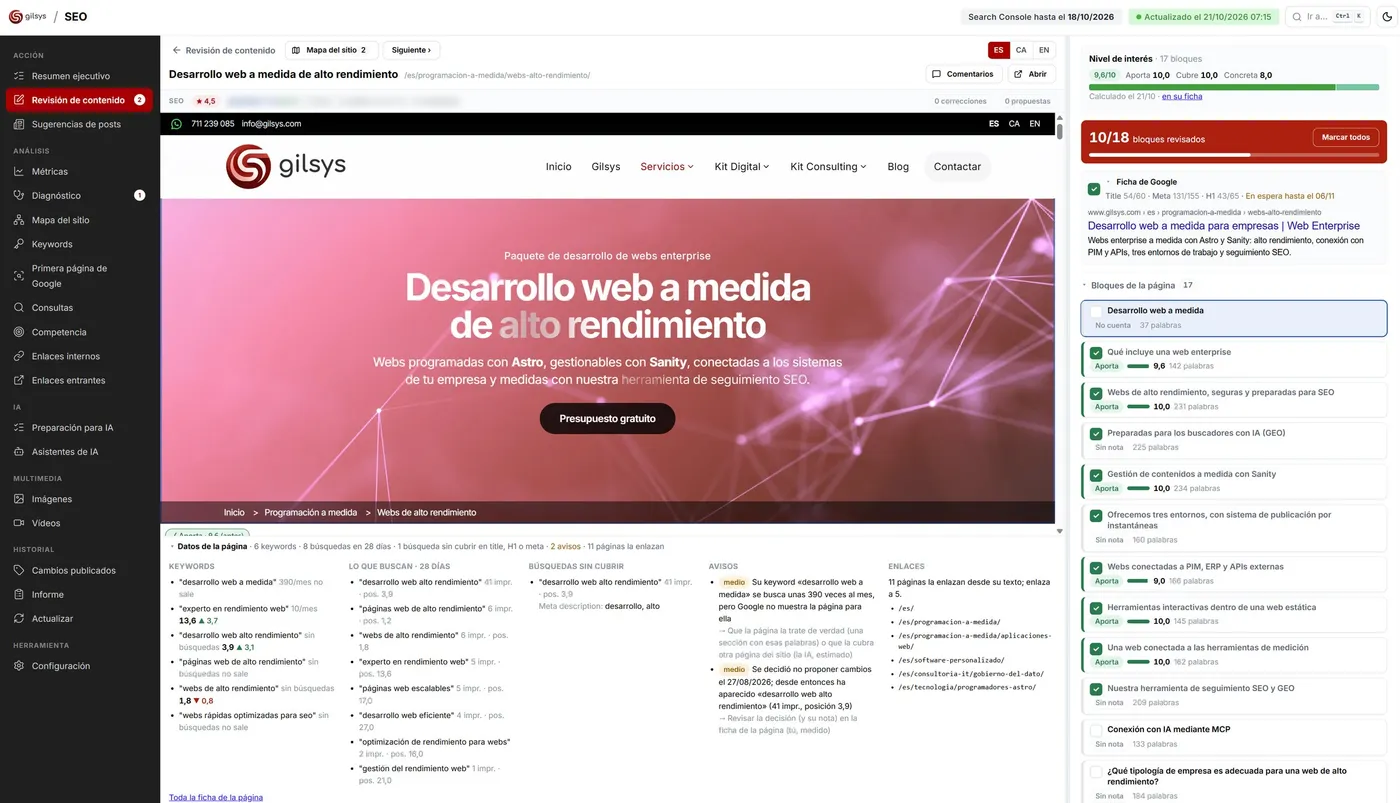
We have developed a tool that, based on the data recorded by all our measurement systems and trained with our own algorithms, monitors performance and proposes improvements to optimize content and improve SEO and GEO organically:
Review of each page, block by block
It assesses the quality of the content of each block against the pages in the top positions on Google (whether it provides its own information, is generic, repeats itself or drifts off topic) and suggests how to improve it.
Daily diagnosis
It updates the ranking, indexing, speed and visits of each page every day, and indicates what is happening and what should be done.
Keyword selection with AI
It proposes which searches are worth tracking, based on their volume, real queries and the company services, and assigns each one to the page that answers it best, so that two pages do not compete with each other.
Competition and AI assistants
Which companies occupy the first page of each search, which questions Google suggests, whether AI answers cite the website and which AI robots read it.
AI connection via MCP
The tool connects with AI assistants via MCP, so that they analyze all the information recorded by the measurement systems and, with SEO and GEO criteria drawn from official sources, provide advice and specific proposals.
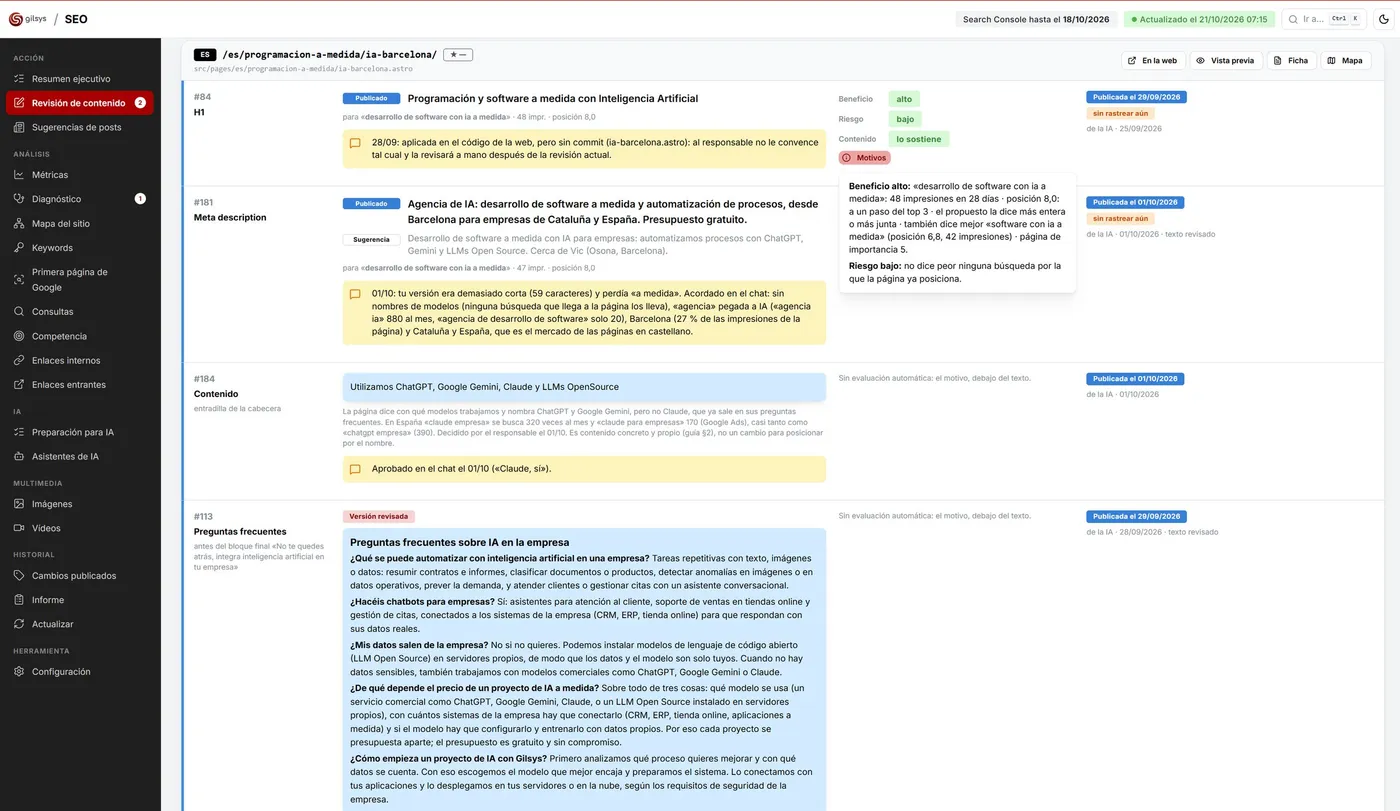
Proposals with risk and benefit
It proposes changes to text, content, links and structured data, with their risk and benefit estimated from the data. No change is published without a person approving it.
Effect of each published version
It assesses the effect of each published change on rankings and traffic and, if results get worse, recommends reverting it.
Images with AI
It generates the website images with AI, from prompts reviewed by a person, and checks that their alternative text describes what they show.
What type of company is a high-performance website suitable for?
An enterprise website suits companies that want a fast, secure website with a strong focus on SEO and GEO, with a custom design, and that their team can manage.
Premium corporate websites
Companies that need to convey a professional image, with high performance and a fully customized design that strengthens their brand.
Companies with product catalogs
Websites that display products, product sheets or series already managed in another system, avoiding duplicated work and data.
Companies focused on advanced SEO
Companies for which ranking among the top positions in search engines or AI is a differentiator, and which want to control the performance of every block on every page and measure the effect of each new version of the site.
Media and content blogs
They need fast publishing and loading of articles, images and multimedia resources, which improve navigation and time on page.
Startups and digital businesses
They need a competitive online presence, with lightweight and scalable code that can evolve with the project.

The enterprise website project adapts to the needs of each company
How to hire it
You can sign up for the website alone with Astro, or add content management with Sanity, SEO monitoring, or both. The monitoring can also be done by the client or by Gilsys.
Astro website
The custom website, with the performance, security and technical SEO of Astro.
+ Sanity
Content management with Sanity, for the whole website (pages, blocks and blogs), with Studio to prepare and publish each version.
+ SEO monitoring, by the client
Access to our SEO/GEO management tool, as a premium SaaS, to consult the data, diagnosis and proposals for their website.
+ SEO monitoring, by Gilsys
From time to time we deliver a report on the SEO/GEO status of the website, with proposed changes reviewed by our team and improvements that the client can apply.
To avoid any doubt, we compare everything we offer with a WordPress website
Enterprise website or WordPress
WordPress can be the most suitable option for certain projects, and it is a technology we also work with at Gilsys. Depending on the project, one or the other is the better fit:
Very tight budget or deadline
WordPress with a commercial template can be launched sooner and with a lower initial investment.
Many standard features
If the project needs to integrate many features that WordPress plugins already offer, such as an online store or a booking system, WordPress covers them with less development.
A website built for the long term
An enterprise website requires a higher initial investment, which pays off through speed, SEO and security, without depending on third-party plugins.
Custom features, with a technical team behind them
In an enterprise website, each feature is programmed for the project and Gilsys extends it with full control of the code. In WordPress, we also develop custom plugins when the project requires it.

Comparison between WordPress and an enterprise website
Speed
WordPress
Every plugin and the theme itself add code and database queries: fast loading requires caching and a lot of optimization.
Enterprise website (Astro)
Prebuilt HTML, no unnecessary JavaScript and images optimized for each device. The pages of gilsys.com average 99.6 out of 100 in PageSpeed for mobile.
Technical SEO
WordPress
Limited to what the theme and SEO plugins allow, which generate HTML that cannot be fully controlled.
Enterprise website (Astro)
Full control of the HTML of each page: tags, URLs, links, headings and structured data.
GEO
WordPress
Depends on the theme and plugins, and the content is often mixed with the code of visual page builders.
Enterprise website (Astro)
Structured data, directives for AI robots and clean content in the HTML, ready for assistants to read and cite.
Content management
WordPress
Free-form editor: the result depends on who edits.
Enterprise website (Astro)
Sanity, with predefined blocks and specific options: professional management, consistent across the website.
Environments and publishing
WordPress
Usually edited on the live website; a test environment depends on the hosting.
Enterprise website (Astro)
Development, integration and Studio, with snapshot publishing and return to previous versions.
Connection with other systems
WordPress
Through plugins or WordPress development.
Enterprise website (Astro)
PIM, ERP or APIs, with prebuilt data in production.
Interactive tools
WordPress
Plugins or code embedded in the pages.
Enterprise website (Astro)
Isolated islands, loaded only when needed.
Security
WordPress
Its popularity and the number of third-party plugins make it a frequent target of attacks, and require constant updates to the core, the theme and the plugins.
Enterprise website (Astro)
No exposed database or admin panel in production: the attack surface is reduced to a minimum.
Scalability
WordPress
Less efficient with a lot of content or traffic.
Enterprise website (Astro)
Handles traffic peaks without slowing down.
SEO monitoring
WordPress
SEO plugins within the website itself, with generic recommendations for each page.
Enterprise website (Astro)
Our SEO and GEO monitoring tool: data from Search Console, Analytics, PageSpeed and other sources, a review of each block and improvement proposals with AI.
Development time
WordPress
Faster at first.
Enterprise website (Astro)
Longer.
Initial cost
WordPress
Lower.
Enterprise website (Astro)
Higher, offset in the long term.
| Aspect | WordPress | Enterprise website (Astro) |
|---|---|---|
| Speed | Every plugin and the theme itself add code and database queries: fast loading requires caching and a lot of optimization. | Prebuilt HTML, no unnecessary JavaScript and images optimized for each device. The pages of gilsys.com average 99.6 out of 100 in PageSpeed for mobile. |
| Technical SEO | Limited to what the theme and SEO plugins allow, which generate HTML that cannot be fully controlled. | Full control of the HTML of each page: tags, URLs, links, headings and structured data. |
| GEO | Depends on the theme and plugins, and the content is often mixed with the code of visual page builders. | Structured data, directives for AI robots and clean content in the HTML, ready for assistants to read and cite. |
| Content management | Free-form editor: the result depends on who edits. | Sanity, with predefined blocks and specific options: professional management, consistent across the website. |
| Environments and publishing | Usually edited on the live website; a test environment depends on the hosting. | Development, integration and Studio, with snapshot publishing and return to previous versions. |
| Connection with other systems | Through plugins or WordPress development. | PIM, ERP or APIs, with prebuilt data in production. |
| Interactive tools | Plugins or code embedded in the pages. | Isolated islands, loaded only when needed. |
| Security | Its popularity and the number of third-party plugins make it a frequent target of attacks, and require constant updates to the core, the theme and the plugins. | No exposed database or admin panel in production: the attack surface is reduced to a minimum. |
| Scalability | Less efficient with a lot of content or traffic. | Handles traffic peaks without slowing down. |
| SEO monitoring | SEO plugins within the website itself, with generic recommendations for each page. | Our SEO and GEO monitoring tool: data from Search Console, Analytics, PageSpeed and other sources, a review of each block and improvement proposals with AI. |
| Development time | Faster at first. | Longer. |
| Initial cost | Lower. | Higher, offset in the long term. |
What sets us apart
Why choose Gilsys to develop an enterprise website?
A system based on our experience
We have designed a system based on our experience: a combination of technologies, with Astro, Sanity and our SEO and GEO monitoring tool, to achieve a website that comes close to excellence.
Applied in other companies
We have applied it in other companies, and all of them have been very satisfied with the result. You can read the reviews we have received.
Regular migrations from WordPress to Astro
Migrating websites from WordPress to Astro is regular work for us: we adapt the content to the new model, optimize the images and set up 301 redirects for the old addresses, so that rankings are not lost.
Tested first on our own website
Before offering it, we tested it ourselves: our own company website moved from WordPress to Astro, a process that allowed us to understand this technology in depth and take advantage of its benefits. If you arrived at this page from a search engine or an AI assistant, that is a sign of a satisfactory result.
More than 20 years of custom development
Building an integration of this kind and, when needed, connecting other company tools requires advanced knowledge of software development: it is not enough to hand everything over to AI through vibe coding.
Custom design, layout and development
We start from the client's design in Figma, a custom design or a commercial HTML5 template, and build it as our own Astro theme. The CMS and its blocks are also custom-built, so the client gets a website adapted to their needs. It is not an experiment: we have the know-how to determine what works and what does not.
Frequently asked questions about enterprise websites
Do you guarantee an improvement in SEO and GEO?
How much does a custom enterprise website cost?
Where are Astro projects hosted?
Is a paid Sanity account needed?
Can the whole website be managed from Studio, or only some sections?
What happens if the PIM or an external API stops responding?
Can you migrate our website from WordPress or another platform?
What is delivered at the end of the project?
Does your company need an enterprise website?
We will assess whether a website like this suits your project and prepare a personalized quote.