

Near Vic (Osona), in the province of Barcelona, Spain
Custom development and software with artificial intelligence
We automate processes and build applications that interpret information and make decisions, integrating commercial AI models (ChatGPT, Gemini, Claude) or open-source models on private servers.
Ways to implement AI in a company
Through AI consulting, we will analyze your company and determine which one to apply first.
AI agents
Unattended systems that look up information, decide the next step, and carry out the action in the ERP, the CRM, email, or files, always with the permissions assigned to them.
AI automation
Predefined workflows that are triggered by an event, such as the arrival of an invoice, an email, or a document. The AI decides how to process it and the workflow continues automatically.
Private AI
Open-source models in a private cloud or on the company's servers, connected to its data without the information leaving the organization.
AI in your applications
We integrate artificial intelligence models into your applications to solve what a rule-based program cannot: interpreting, classifying, validating against criteria, generating, or answering.
AI for manufacturing
We connect the machines in the plant, unify their data, and develop an AI system that answers in natural language, monitors, and sends alerts.
What AI makes possible in software development and automation
AI lets us handle situations that until now required human intervention or extremely complex code.
Deciding by criteria, not by rules
A conventional program needs a written condition for each case and, when it meets one that was not foreseen, it stops or accepts it unchecked. With AI, the criteria are defined in natural language and are also applied to cases that had not been anticipated.
Understanding unstructured information
Business software requires each piece of data to arrive in its own field. AI interprets emails worded in any way, PDFs in each supplier's format, or entire conversations, and extracts the data needed to automate the process.
Changing behavior without modifying code
Previously, adjusting a criterion meant modifying the software and deploying a new version. If the criterion is written in natural language, users can adjust it themselves, with no programming needed.
Answering with the company's knowledge
Answers are based on the company's internal documents and data, which change over time, not on fixed rules or on the model's general knowledge, and each one shows where it comes from.
Integrating AI into a company is programming work
Would you put your family in a car built with AI by someone who knows nothing about mechanics?
Developing a basic tool with artificial intelligence seems simple; making it secure, maintainable, and integrated into the company is not. The difficulty begins after the first prototype: getting that AI to read the ERP data, write to the program the team uses, and respect each person's permissions.
That work is no longer about configuring a tool, but about programming. That is why an AI development company can carry out both the assessment and the implementation: the same team that studies where AI fits in develops the software that integrates it, with no intermediaries and no information lost between those who analyze and those who develop.
"AI gives programmers superpowers, but judgment cannot be automated."
Jordi Gil, founder of Gilsys, in an interview with MetaData
AI inside the system
Integrated into the company's corporate tools, not in a separate window where information has to be copied and pasted.
With each user's permissions
Each person gets answers from the information they already have access to, not from the whole system.
With maintenance and further development
We maintain and further develop the solutions we implement. We know at all times how they are built: they are not a black box that simply works.
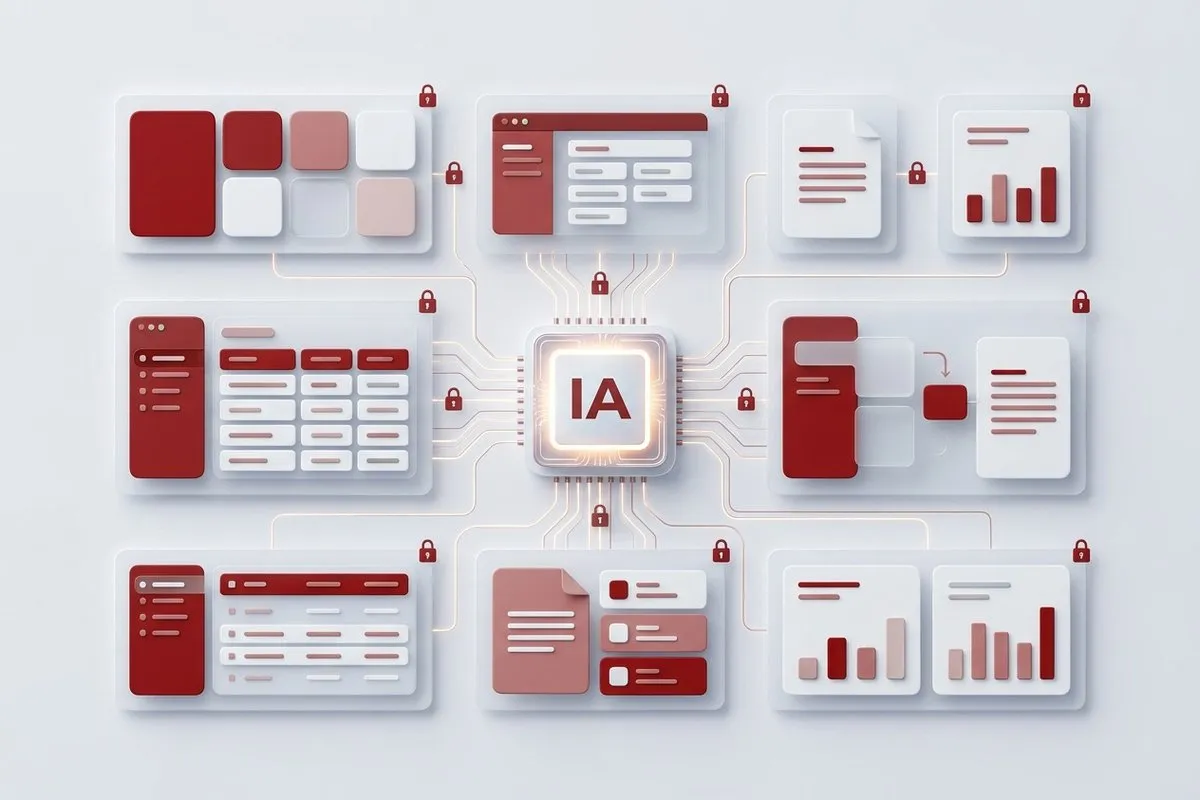
Which AI model is used in each project?
It is the first decision and it shapes everything else: the cost, the speed, and what information leaves the company, but it does not have to be final.
A commercial model
ChatGPT, Gemini, or Claude. They are usually the most capable, are paid for by usage, and require no maintenance. The trade-off is that the information sent to them leaves the company and the price depends on a third party. It is the right option when the information being processed is not sensitive.
An open-source model on private servers
It is installed on a server the company controls, and the tool belongs to the company. Neither the documents nor the questions leave the organization, and the cost is that of the server, not of usage. The trade-off is that it has to be sized and maintained: this is what we implement in a private AI project.
A gateway for switching models
We connect the application to a model gateway, for example LiteLLM, instead of to a specific provider. This makes it possible to switch language or reasoning models, split traffic among several, or replace one that has gone up in price without modifying the code or redeploying. In a field where a better model appears every few months, this is an important advantage.
The same for image generation
To generate or edit images we use platforms such as Fal.ai, which give access to many image models through a single integration. Several are tested with real examples, and we switch to the one that gives the best result or the best price without rebuilding the tool.
AI inherits the company's data
When we integrate artificial intelligence into a company, we almost always start from the existing infrastructure. That is why three aspects need to be reviewed before writing a single line of code.
Incomplete data gives an incomplete answer
If the information is duplicated or incomplete, an AI system returns duplicated or incomplete answers, and presents them as true. The model cannot tell correct data from wrong data: it treats both the same.
AI also helps put the data in order
The same models detect duplicates that are not identical, fields with filler values, and values that do not fit with the rest, and collect them in a list for a person to decide. This is data governance work, and it is done before the AI project or in parallel with it.
A system with rules for each type of information
Each type of information needs a system with rules: a product information management system for the catalog, a document management system for files, or the tool the company already uses for each case.
With the information in order, an AI project costs less
With a well-organized database, the project moves faster and the results are more reliable. That is why, in many projects, the first proposal is not about AI but about putting the data in order.
Frequently asked questions about AI in business
What can be automated with artificial intelligence in a company?
Do you build chatbots for businesses?
What does the price of a custom AI project depend on?
How does an AI project with Gilsys start?
Do you only work with companies in Barcelona?

What task is repeated every day in your company?
Tell us what it is and what data it relies on today. In a first conversation, free of charge, we will assess whether AI can solve it.